
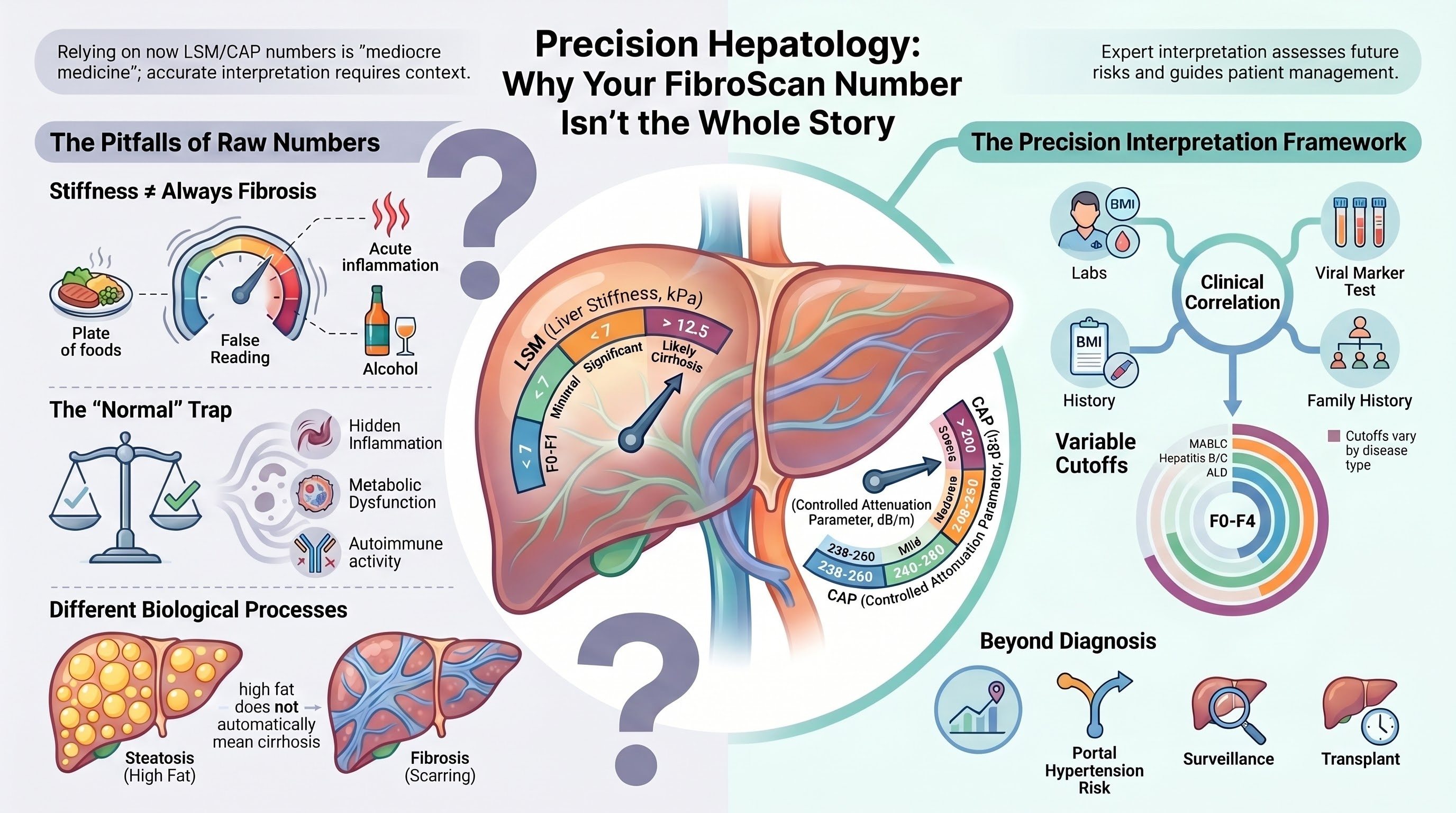
FibroScan Interpretation — Precision Matters More Than the Number
Most FibroScan reports are being oversimplified.
That is the truth.
A single stiffness number without clinical context is mediocre medicine pretending to be precision hepatology.
What a FibroScan Actually Measures
A FibroScan primarily evaluates:
1. Liver Stiffness (Fibrosis)
Measured in kPa (kilopascals)
Higher stiffness generally suggests:
Fibrosis
Advanced fibrosis
Cirrhosis
But stiffness can also rise from:
Acute hepatitis
Congestion
Cholestasis
Alcohol use
Inflammation
Food intake before test
Severe fatty liver
Technical error
So treating a FibroScan like a biopsy replacement in every patient is lazy interpretation.
General Fibrosis Interpretation Framework
Liver Stiffness Measurement (LSM)
F0–F1<7kPa, F2≈7–9.5kPa, F3≈9.5–12.5kPa, F4>12.5kPa
Broad Clinical Meaning
F0–F1: Minimal/no fibrosis
F2: Significant fibrosis
F3: Advanced fibrosis
F4: Cirrhosis likely
But these cutoffs vary depending on:
MASLD/NAFLD
Hepatitis B
Hepatitis C
Alcohol-related liver disease
Congestive hepatopathy
Anyone giving universal cutoffs without disease context is oversimplifying hepatology.
CAP Score (Fat Quantification)
CAP = Controlled Attenuation Parameter
Measured in dB/m
Approximate Fatty Liver Grading
S1≈238–260dB/m, S2≈260–290dB/m , S3>290dB/m
Meaning
S1: Mild steatosis
S2: Moderate steatosis
S3: Severe steatosis
But CAP alone does NOT tell you:
inflammation severity
fibrosis progression speed
transplant risk
portal hypertension
cancer risk
That requires integrated hepatology assessment.
The Biggest Clinical Mistakes
Trash Interpretation #1
“FibroScan normal = liver healthy”
Wrong.
Patients can still have:
inflammation
metabolic dysfunction
early disease
alcohol injury
autoimmune activity
Trash Interpretation #2
“Fatty liver grade 3 = cirrhosis”
Wrong.
Steatosis and fibrosis are different biological processes.
Trash Interpretation #3
“High stiffness automatically means cirrhosis”
Wrong again.
ALT flare, acute hepatitis, alcohol binge, congestion, or cholestasis can transiently elevate stiffness.
Proper FibroScan Interpretation Requires
Clinical Correlation
Symptoms
BMI
Diabetes/metabolic syndrome
Alcohol history
Viral markers
Autoimmune profile
Medications
Family history
Lab Correlation
AST/ALT
Bilirubin
INR
Albumin
Platelets
Imaging Correlation
Ultrasound
CT
MRI
Portal vein status
Spleen size
Risk Stratification
Portal hypertension risk
HCC surveillance need
Decompensation probability
Transplant timing
That is real hepatology.
Not reading one PDF and declaring “all okay” or “cirrhosis confirmed.”
Expert FibroScan Interpretation & Liver Fibrosis Assessment
Dr. Chetan Kalal provides advanced interpretation of:
FibroScan reports
Liver fibrosis staging
Fatty liver severity
Cirrhosis risk assessment
Portal hypertension risk
Transplant timing decisions
Discordant or confusing liver reports
For many patients, the real question is not:
“Is the FibroScan abnormal?”
The real question is:
“What does this mean clinically, and what happens next?”