A FibroScan result is useful only when the test is prepared correctly, reported with its quality details, and interpreted alongside blood tests and metabolic history. By the end, you will know how to prepare, read the key numbers, and use repeat testing to track fatty liver without treating one scan as a diagnosis.
Key takeaways
- Fast for at least three hours before your FibroScan appointment.
- Take regular medicines with a small amount of water unless told otherwise.
- Review measurement quality before interpreting kPa or CAP results.
- Compare follow-up readings under similar conditions to monitor change.
Prepare correctly and know what happens during the appointment
A FibroScan is a form of non invasive liver testing, so preparation is simple but affects accuracy. Avoid food for at least three hours beforehand, or follow the appointment centre’s specific fasting instruction. Take regular medicines with a small amount of water unless your clinician tells you not to.
Recent meals can temporarily alter liver stiffness and produce a less dependable result.
Tell the operator if you have marked abdominal fluid, a large abdomen, narrow spaces between the ribs, or previous difficulty obtaining scans. These factors can require a different probe or make measurement harder. Wear clothing that allows access to the right side of your upper abdomen.
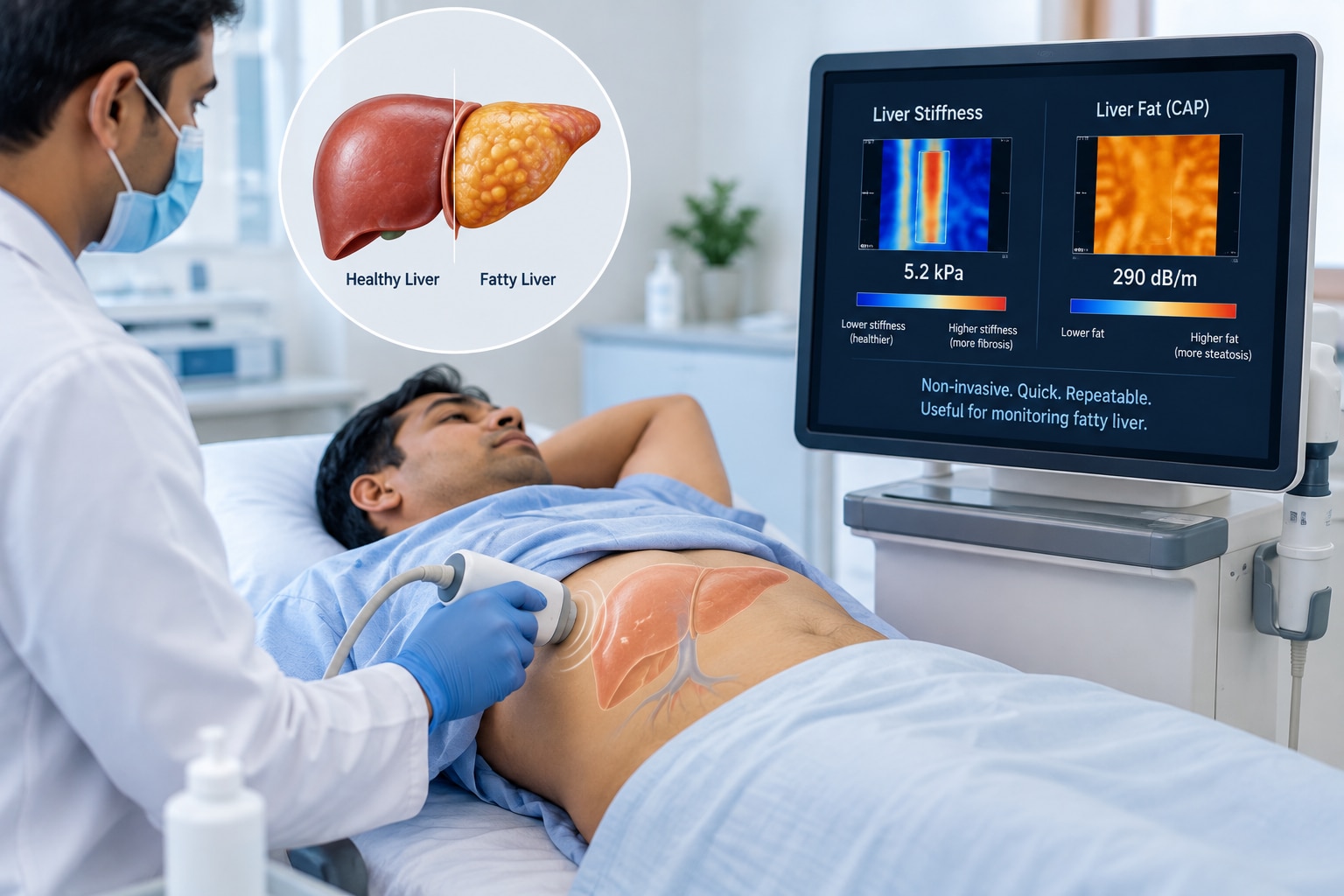
- You lie on your back with your right arm raised behind your head, opening the spaces between your ribs.
- The operator applies gel and places the probe between the ribs over the liver.
- The device sends brief vibrations into the liver and records several measurements. The appointment usually takes only a few minutes.
- You feel repeated light taps or pulses against the skin. The test does not involve needles, injections, or cutting, and it should not hurt.
Ask for a report showing liver stiffness in kPa and fat estimation through CAP in dB/m. Before booking a FibroScan in Mumbai, confirm that fasting status and probe type will be recorded; these details help a clinician interpret the result rather than treat one number as a diagnosis.
Check whether the measurement is technically dependable
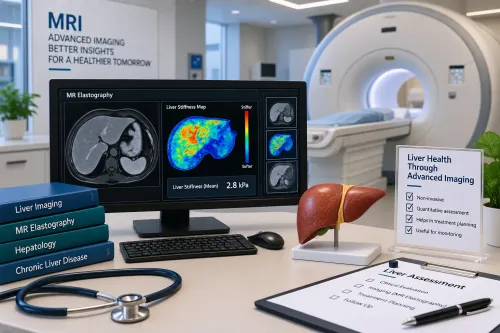
FibroScan produces a liver stiffness measurement by sending a controlled vibration through the liver and using ultrasound to track the resulting shear wave. A faster wave indicates stiffer tissue, and the device reports that stiffness in kilopascals (kPa).
It also reports the controlled attenuation parameter (CAP) in dB/m, which estimates liver fat rather than inflammation or liver function.
A credible report should show more than a single kPa number:
| Report detail | More dependable finding | What raises concern |
|---|---|---|
| Valid measurements | At least 10 valid shots | Fewer than 10 |
| Variability | IQR-to-median ratio 0.30 or less when median LSM exceeds 7.1 kPa | Higher ratio |
| Probe | M or XL probe clearly named | Probe type missing |
| Patient conditions | Fasting status recorded | Recent meal or fasting status absent |
| Technical performance | Success rate reported alongside valid-shot count | Success rate shown alone |
The XL probe is designed for people with obesity or a thick chest wall, while narrow rib spaces, abdominal fluid, or poor probe contact can reduce feasibility. Do not compare kPa values as interchangeable when different probes were used. For repeat monitoring, use comparable fasting conditions and, where possible, the same laboratory and probe type.
This non invasive liver testing result still needs clinical context, including liver enzymes, platelet count, FIB-4, and metabolic history.
Read kPa and CAP without turning them into a diagnosis
A kPa value estimates liver stiffness measurement, while CAP estimates liver fat; neither number alone diagnoses fatty liver, inflammation, cirrhosis, or liver failure.
| Reading | What it indicates | What it cannot prove |
|---|---|---|
| LSM in kPa | Higher stiffness can reflect more fibrosis | Fibrosis is not the only cause of a high result |
| CAP in dB/m | Higher attenuation suggests more liver fat; around 275 dB/m or above is often used for at least mild steatosis | CAP cannot stage fibrosis or identify steatohepatitis |
A recent meal can temporarily raise kPa, so fast for at least 2–3 hours and compare follow-up tests under similar fasting conditions. Liver inflammation from hepatitis or another active injury, bile-flow obstruction, and liver congestion from right-sided heart failure can also make stiffness look worse than established fibrosis.
Ascites, obesity, narrow rib spaces, or an unsuitable probe can produce technically unreliable readings; an XL probe may improve testing in obesity, but the report must name the probe.
CAP is affected by body mass index, diabetes, probe choice, and the amount of fat present. A high CAP supports steatosis, but it does not measure inflammation or liver function.
Read the numbers with AST, ALT, platelet count, metabolic history, and a FIB-4 score. Ask for the fasting status, probe type, number of valid measurements, and variability before comparing dates. A single alarming value deserves clinician review, not self-directed treatment.
Use FibroScan to detect risk early and monitor change over time
Use FibroScan for early liver disease detection when you have fatty liver risk, abnormal liver enzymes, obesity, diabetes, heavy alcohol use, or a family history of liver disease. Calculate FIB-4 first from age, AST, ALT and platelet count; use vibration-controlled transient elastography when FIB-4 is indeterminate or elevated.
A liver stiffness measurement is not a standalone diagnosis.
Repeat testing when your clinician needs to assess fibrosis-risk direction, not to judge day-to-day treatment response. Continue lifestyle treatment even when stiffness is low: losing 3–5% of body weight can reduce steatosis, while 7–10% or more is linked with greater improvement in steatohepatitis and fibrosis risk.
Compare dates only after checking these factors:
- Fast for at least 2–3 hours before each test. A recent meal can temporarily raise stiffness.
- Use the same probe type and, where possible, the same service.
- Review valid measurements, variability, CAP, liver enzymes, platelet count, weight and metabolic control together.
- Investigate sudden changes before calling them fibrosis progression; inflammation, congestion, technical variation and inconsistent preparation can alter kPa.
| Factor | Compare at both dates | Why it matters |
|---|---|---|
| Fasting | 2–3 hours without food | Meals can falsely raise stiffness |
| Technique | Probe type, valid readings and variability | Technical differences can mimic change |
| Clinical context | AST, ALT, platelets, weight and diabetes control | FibroScan cannot explain the cause alone |
| Interpretation | Sustained trend, not one kPa shift | Short-term changes are not treatment failure |
Choose a Mumbai service that gives you an interpretable report
Ask before booking whether the service provides LSM in kPa and CAP in dB/m, records fasting status and probe type, and reports the number of valid measurements with variability. A number without this context is difficult to interpret.
Request confirmation that a clinician will review the result alongside FIB-4, AST, ALT, platelet count, alcohol intake, diabetes, weight history and other medicines. This is especially important when arranging Fibroscan in Mumbai for early liver disease detection.
- Ask whether an XL probe is available if you have obesity or a thick chest wall.
- Take your previous blood tests and imaging, not only the scan report.
- Ask who will explain the result and what follow-up is included.
Use the result as a risk assessment, not a prescription for self-directed weight treatment.
| Result or finding | Appropriate next step | Why |
|---|---|---|
| Low or reassuring LSM | Continue clinical monitoring | It does not exclude inflammation, mild fibrosis or non-liver causes of abnormal tests |
| Indeterminate or elevated FIB-4 | Hepatology review | FibroScan should be interpreted with blood counts and liver enzymes |
| LSM suggesting advanced fibrosis or cirrhosis | Prompt hepatology assessment | You may need repeat elastography, ultrasound, platelet review or portal-hypertension evaluation |
| Persistent abnormal ALT, AST, bilirubin, platelets or imaging | Medical evaluation | A normal LSM cannot explain every liver problem |
A service such as Dr Chetan Kalal Hepatologist Transplant is useful when the report is connected to diagnosis, risk staging and follow-up rather than handed over as an isolated number.
Related service
Non Invasive Assessment Of Fatty Liver Fibroscan FibroScan: The Gold Standard for Non-Invasive Liver Assessment FibroScan (Transient Elastography) is an advanced, non-invasive diagnostic tool used... |
Frequently asked questions
How should you prepare for a FibroScan appointment?
Avoid food for at least three hours before the scan, or follow the centre’s fasting instruction. Take regular medicines with a small amount of water unless your clinician advises otherwise.
What makes a FibroScan measurement technically dependable?
Check the report for the measurement quality details, including the number of valid readings and whether the result is suitable for interpretation.
What do kPa and CAP mean on a FibroScan report?
kPa indicates liver stiffness, while CAP estimates liver fat. Interpret both alongside your history, examination, blood tests, and imaging rather than treating either value as a diagnosis.
How can FibroScan help monitor fatty liver?
Repeat testing can help identify changes in liver stiffness and fat when results are compared over time under similar conditions. It supports early liver disease detection but does not replace clinical assessment.
Keywords