A stiffness result is not a direct photograph of liver scarring, and the same kPa number can mean different things depending on the test, disease, and examination quality. By comparing the technology, preparation, reliability markers, limitations, and clinical use of both tests, you can choose a more suitable fibrosis assessment and ask the right questions about your report.
Key takeaways
- FibroScan is quick and affordable, but obesity, ascites, and inflammation can affect results.
- MR elastography maps liver stiffness across a larger volume and works well in complex cases.
- Neither test directly measures scar tissue; interpret stiffness with blood tests and clinical findings.
- Ask your hepatologist which test fits your body size, implants, symptoms, and diagnostic question.
What liver stiffness measurement actually tells you
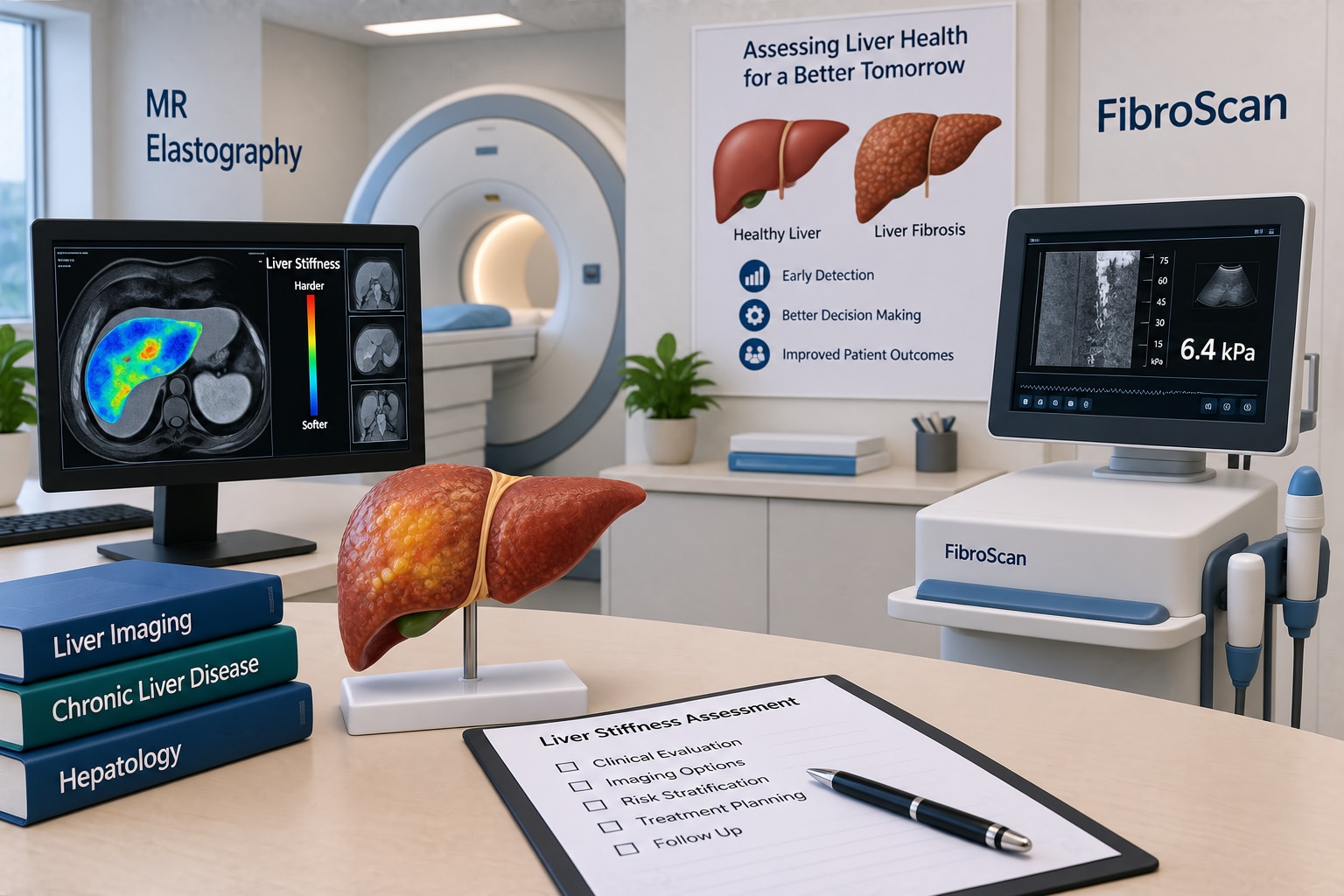
A liver stiffness measurement describes how readily shear waves travel through liver tissue: scarred tissue is less pliable, so increasing collagen from fibrosis usually produces a higher value. FibroScan, formally vibration-controlled transient elastography (VCTE), and MR elastography measure stiffness; neither directly measures scar tissue.
Stiffness can rise without permanent fibrosis when the liver is temporarily changed by:
- acute hepatitis or other active inflammation
- blocked bile flow, called cholestasis
- hepatic congestion from heart failure
- a recent meal
A high result therefore needs interpretation alongside liver enzymes, bilirubin, platelet count, imaging, medications, and the underlying liver disease. Stiffness and fat are different measurements: fatty liver does not automatically mean advanced fibrosis. VCTE may estimate fat with controlled attenuation parameter (CAP), while MRI can quantify it with MRI-PDFF when that sequence is available.
A low result is reassuring about diffuse stiffness, but it does not exclude every serious liver problem outside that measurement. Elastography provides useful liver biopsy alternatives for non-invasive fibrosis risk assessment, not a universal replacement for biopsy.
If non-invasive results remain discordant, the diagnosis is uncertain, or tissue findings will change treatment, a biopsy may still be appropriate.
How FibroScan works and when its result is reliable
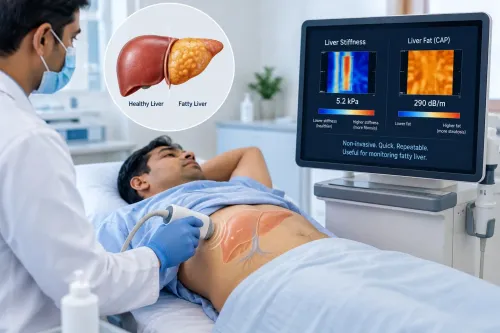
A FibroScan examination usually takes 5–10 minutes. After fasting for about three hours, you lie on your back with your right arm raised while the operator places a probe between your ribs. The probe sends a painless vibration and ultrasound wave through the liver, then reports a liver stiffness measurement in kilopascals (kPa).
The operator selects the standard M probe or the larger XL probe when body build makes the usual probe unreliable.
A dependable report contains more than one kPa value. Check for these quality indicators:
- At least 10 valid measurements
- A success rate above 60%
- The interquartile range (IQR) divided by the median stiffness, preferably 0.30 or less
- The probe used, especially whether an XL probe was needed
- A clear note if measurements were difficult or failed
Obesity, thick tissue, narrow spaces between the ribs, and ascites can reduce accuracy. Ask for a repeat examination when the report has too few valid readings, wide variation, no probe information, or a result that conflicts sharply with your blood tests and imaging.
A technically valid result can still be temporarily high after eating or during active hepatitis, bile-flow obstruction, or heart-related liver congestion. For fibrosis assessment in Mumbai, schedule the scan after the advised fast and have the clinician interpret stiffness alongside platelets, liver enzymes, bilirubin, and the underlying diagnosis.
What to expect from an MR elastography liver scan
An MR elastography liver scan begins with MRI safety screening: disclose metal implants, pacemakers, clips, retained metal fragments, and possible pregnancy. Follow the centre’s fasting instruction, often several hours without food, because a recent meal can affect stiffness. FibroScan usually needs fasting too, but does not require MRI screening.
| Stage | MR elastography | FibroScan |
|---|---|---|
| Preparation | Wear MRI-safe clothing; remove metal; follow fasting instructions. | Follow fasting instructions; expose the right upper abdomen. |
| Scanning | Lie still while a driver placed against the abdomen sends shear waves through the liver. Expect loud MRI noise and repeated breath-holds; claustrophobia can matter. | Sit or lie while a probe sends painless vibrations through the liver between the ribs. The examination is usually much shorter. |
| Reporting | Reports liver stiffness from a larger liver volume and identifies the MRI elastography technique, quality information, and any additional MRI findings. | Reports VCTE stiffness, probe type, measurement quality, and often CAP, an estimate of liver fat. |
MRE stiffness does not require contrast, although contrast can be added when the same MRI examination must assess lesions or other abdominal findings. Ask whether the scan includes MRI-PDFF for fat quantification; stiffness and fat are separate measurements.
Do not compare the headline kPa number with a FibroScan result as if the cut-offs were interchangeable. Check fasting status, technique, quality or failure indicators, and the disease-specific reference range used by the interpreting clinician.
Which test fits obesity, ascites, implants, and complex cases
Obesity, ascites, or an MRI-risk implant can change which test produces a usable liver stiffness measurement. The choice in MR elastography versus Fibroscan in Mumbai should follow technical validity, not the higher or lower kPa number.
| Patient factor | FibroScan (VCTE) | MR elastography |
|---|---|---|
| Obesity | Thick tissue or narrow rib spaces can cause failure; an XL probe and documented valid readings help. | Samples a larger liver volume and is often more dependable, but the MRI bore may not accommodate every body size. |
| Ascites | Fluid can prevent reliable wave transmission and produce failed or inconsistent readings. | Usually handles ascites better and maps a broader liver area, though severe fluid or poor breath-holding can still affect the scan. |
| Implants | Usually unaffected by implanted cardiac devices or metal hardware. | Requires MRI safety clearance; non-compatible pacemakers, certain neurostimulators, metal fragments, or severe claustrophobia can exclude the examination. |
| Complex or discordant results | A single intercostal window can miss uneven disease. | The larger sampling area helps when VCTE conflicts with blood tests, imaging, or the clinical picture. |
Do not apply a FibroScan threshold to an MRE result. Use the cut-off validated for that method, the underlying disease, and the laboratory’s units and technique. Ask whether the report states the probe, valid-measurement count, variability, fasting status, and MRE sequence.
A high value from either test can reflect inflammation, biliary blockage, heart-failure congestion, or a recent meal rather than fixed fibrosis. Interpret it with enzymes, bilirubin, platelets, imaging, and clinical history.
Choosing between the two tests in Mumbai
Start with FibroScan when you need a quick, accessible test for routine fibrosis assessment in Mumbai, particularly after a FIB-4 score is indeterminate or elevated. It is usually the practical first choice for outpatient follow-up, provided the operator obtains valid measurements.
MR elastography is worth the extra time and access requirements when FibroScan readings are unreliable, the body habitus limits VCTE, or the hepatologist needs a more comprehensive assessment in a complex case. MRE requires MRI availability, safety screening, breath-holding and stillness; it can also fail because of motion, iron deposition, incompatible devices or claustrophobia.
| Option | Practical advantage | When it fits |
|---|---|---|
| FibroScan | Fast, focused, easier to repeat | Initial assessment or monitoring with a dependable quality result |
| MRE | Larger liver assessment within an MRI examination | Discordant results, difficult VCTE, or complex liver disease |
A report should name the method, probe or MRI technique, quality indicators, fasting status and reference range. Do not compare an MRE kPa threshold directly with a FibroScan threshold.
These liver biopsy alternatives measure stiffness, not fibrosis itself. A hepatologist should compare the result with AST, ALT, bilirubin, platelet count, imaging, medications, alcohol exposure and signs of inflammation, obstruction or heart failure. Dr Chetan Kalal Hepatologist Transplant can use that combined evidence to decide whether monitoring, further testing or biopsy is justified.
Repeatedly discordant results or an uncertain diagnosis still warrant biopsy consideration.
Related services
Medical Imaging | Liver Diagnostics | Hepatology Services Advanced Liver Fibrosis & Fatty Liver Diagnosis Magnetic Resonance Elastography (MRE) – A Breakthrough in Liver Health & Transplant Evaluation Liver diseases like fatty liver, cirrhosis, and... View service → |
Preventive Health & Wellness Clinic (with sub-focus: Liver Health, Lifestyle Medicine, and Early Screening) Preventive Liver Health Check & Lifestyle Screening The Preventive Liver Health Check & Lifestyle Screening Program by Dr. View service → |
Frequently asked questions
What does a liver stiffness measurement tell you?
It estimates how readily shear waves travel through liver tissue. Fibrosis often raises stiffness, but inflammation, congestion, cholestasis, meals, and technical factors can also affect the result.
How does FibroScan work, and when is its result reliable?
FibroScan, or vibration-controlled transient elastography, sends a mechanical vibration through the liver and measures shear-wave speed. Reliability depends on adequate valid measurements, an appropriate probe, correct positioning, and avoiding factors such as recent food intake or acute liver inflammation.
What should you expect from an MR elastography liver scan?
MR elastography uses an external driver to generate shear waves while MRI sequences map their movement through the liver. You lie still in the scanner, follow breath-holding instructions, and complete the scan without a needle or tissue removal.
Which test is better for obesity, ascites, implants, or complex cases?
MR elastography often provides more complete liver coverage in obesity and difficult body shapes. FibroScan can be limited by excess tissue or fluid, while MRI requires screening for metal implants and may be unsuitable for people who cannot tolerate the scanner.
How do you choose between MR elastography and FibroScan in Mumbai?
Choose after reviewing your body size, ascites, liver enzymes, ultrasound findings, implants, claustrophobia, availability, and the exact question your hepatologist needs answered. A hepatologist can also decide whether blood tests, imaging, or liver biopsy is necessary.
Related services
Fatty Liver Disease Fatty liver disease is identified by the existence of excessive fat in the liver. View service → |
✅ Primary Service Type/Category: Hepatology & Liver Disease Consultation ✅ Sub-Categories (Optional, for better filtering/navigation): Liver Disease Diagnosis & Management Fatty Liver & Cirrhosis Treatment Hepatitis B & C Specialist Care Liver Transplant Evaluation & Follow-up Virtual Second Opinion for Liver Conditions Nutritional & Lifestyle Guidance for Liver Health Whether you're dealing with fatty liver, hepatitis B/C, liver cirrhosis, or need post-transplant follow-up, Dr. View service → |
Keywords